

Heads up: some links below are affiliate or referral links. I only ever link things I actually use.
LIVE WELL
We Left Traditional Health Insurance in January and Our Family of Four Has Saved At Least $12,000
What this is
I’ve already told the story about how I left my corporate job a few years ago. My husband left his corporate job last November (yay!) and so our corporate subsidized health insurance ended on December 31. After lots of research, we opted to not replace it with traditional insurance. What we joined instead is called CrowdHealth, which is a crowdfunding company. We pair it with a direct primary care practice we have belonged to for ten years, but that’s because we chose to join a DPC 10 years ago, not because we dropped insurance.
This post is what that change has actually cost us month by month since January, and everything I looked at and ruled out before we landed here. There’s an ER visit included. There’s also a list of people this is a genuinely bad idea for, so I know this won’t be for everyone.
I’m sharing it all below, including every number from our own bank statements. Not to convert you, but to remind people there are alternatives out there to a very broken healthcare system.
The story
First let me acknowledge something about this switch: It was scary! I’ve had health insurance since I was a kid. First on my mom’s plan through college, then on my own through a corporate job. I carried my own family on my plan and when I left my corporate job, my husband’s corporate insurance took over for the family. So this is the first time in my whole life that we have no traditional coverage. “The System” has always said this is BAD so before this year we just kept doing it because we were “supposed” to have this type of insurance.
But in the last couple of years, after doing my own research, I’ve intentionally gone against the system in a lot of areas of my life. I quit a corporate job. I started homeschooling my kids. I see an energy healer and a homeopath before heading to conventional doctors. Apparently this is just the next system where I’m finding my way against the mainstream because it feels like what’s right for my family. I think a lot of these systems that exist in our society are just straight up broken right now. Until there are new systems, I’ve just been navigating my way out of the old ones.
We were already paying out of pocket for almost everything
Let me back up. For ten years we’ve been part of a Direct Primary Care (DPC) practice and we paid for that ourselves, on top of the insurance premiums coming out of our paychecks. DPC are doctors where they don’t take insurance typically and you pay a monthly fee but you have unlimited access to the physicians and they take the time to get to know you because the 15 min appointments mandated by insurance don’t come into play. We joined a practice when my oldest was a baby because we wanted a family doctor that actually knew our family. They don’t take insurance but we stayed on our insurance plan in case there was an emergency and someone needed to go to the ER or for our yearly labs or if we needed to see a specialist. Additionally, I was seeing a naturopath and a chiropractor regularly, both of which insurance doesn’t typically cover.
We always felt like insurance was a huge expense we didn’t get much benefit from. The last full year of his plan, 2025, the total cost of our coverage was $17,516.16. I only know that because it printed on his W-2 in a random box lol. Our share of that was around $260 a paycheck, every two weeks, so his company did pay a large chunk of it, but we still paid close to $7,000 in premiums for our family of 4 for just medical.
And on top of that, the deductible before insurance actually kicked in any coverage was about $5,000 PER PERSON PER YEAR. We never reached it in all those years, so we were paying out of pocket for everything anyway, PLUS all those premiums on top.
We understood all along we were buying catastrophe insurance with those premiums and that deductible, but we just never realized there were other ways to do that.
What we looked at, and what happened to each one
When we knew we were going to lose our insurance, we started doing some research on options. COBRA would have been astronomical. It’s stopgap insurance and it isn’t really a long term solution.
So, my husband pulled the actual ACA NC Marketplace numbers on December 3. I dug up the email for this article to get the info right. For a family of 4, with no subsidy: Bronze was $1,681 a month with a $14,000 deductible, Silver was $2,163 with $11,000, and Gold was $2,312 with $3,600. With traditional insurance, since we have our own business now, we would have been able to pay for these pre-tax which does have some tax savings. My husband did the math and said after tax benefits, to compare apples to apples to anything else, we’d likely be paying $1,300 to $1,400 a month and still have at least an $11,000 deductible. If we weren’t starting our own business though, I’m not sure the tax benefits are there.
Those are OUR quotes, at our income, with no subsidy applied (we didn’t qualify). If your household income is lower, or you live in a different state, you could be quoted far less, so please go run your own before you compare yourself to us.
Since we truly got NOTHING out of the insurance we had for so many years I started to research other options. I’d heard people talking about “shares” so I started to dig into those. Some of the Christian Ministry shares require you to be of a certain religion and some don’t, and some have morality clauses (a lot of them won’t allow birth control or abortions). I know that’s a hot topic on both sides of the political aisle so if you’re considering those I’m just being transparent.
There are non-religion based shares out there too and after my initial research I was going to go with one of those because on paper it seemed like the best fit. I was ready to pull the trigger then my intuition told me to do a little more research on actual reviews from real people, not just what the brochures say. By doing that I found out some were taking upwards of six months (or more!) to refund people for what they’d already paid out of pocket, even when it was approved, and it was a long process with a lot of chasing and following up and following up again and submitting more paperwork. People described my nightmare and why insurance gets a bad rap too. The system is built to DENY and then fight to get coverage and then YOU have to drag the process forward yourself. No thank you.
The one I almost picked (before looking at real people reviews) offered more alternative health allowances though - actual money up front toward a naturopath or a chiropractor - and I wanted that. I still want it. But if you have to fight to get that money back, and you might not get it for six months or more, and they still get a say in whether you get it at all, was it really worth the extra small amount you might save?? For me the answer was no, and I gave up the thing I actually wanted (coverage of alternative care!) to get the thing I needed more (less hassle). I was already used to paying out of pocket for all my alternative care anyway.
Why we landed on crowdfunding instead of a share
The difference between a health share and crowdfunding tripped me up for a while, so I’ll save you the confusion.
A health share is a pool. Everybody pays a fixed monthly contribution into it and the organization pays eligible bills out of it once you’ve covered your share first. The one I almost picked was $658.50 a month, every single month, whether anybody in the pool needed anything that month or not.
CrowdHealth, a crowdfunding type company, has no pool. Each month we get shown specific bills and asked to fund them directly, so our number moves with what the crowd actually needs. You can see it in our own statements. Our funding request (what we had to pay towards other people’s bills) was $151.25 in January and $242.59 in August. A health share would have charged us $658.50 both times.
So that’s what we joined, in January, and a few weeks later I got to really find out how it works.
The ER visit that found nothing
In February I was near Charleston on vacation and something weird was happening with a nerve in my arm. I tried all my normal non-medical things and nothing was working, so after a quick google my husband told me it was time to go to the ER. How did it work with CrowdHealth? I opened it as a health event in the app that same day. Typically if it’s not an emergency you need to open the Health Event in the app BEFORE you receive care, so keep that in mind. But an emergency they always want you to get care first if you need it.
Anyway, back to my ER visit. Arriving at 5am, luckily the waiting room was empty and I was brought back right away. I was in the room maybe fifteen minutes. One doctor, an exam, nothing wrong with me at all. My family dropped me off and stopped for coffee on their way home and I called them to pick me up before they had even left the coffee shop.
I did not pay at the counter, which I assumed I’d have to do (this was my first non-insurance self pay experience lol.) I told them I was self-pay and they just noted it. Both the hospital and the doctor billed me a couple of weeks later, exactly the same as if they’d run it through insurance. Three bills total came in and they added up to $2,291.53. They had done nothing to help me! And yet the system charges an absurd amount.
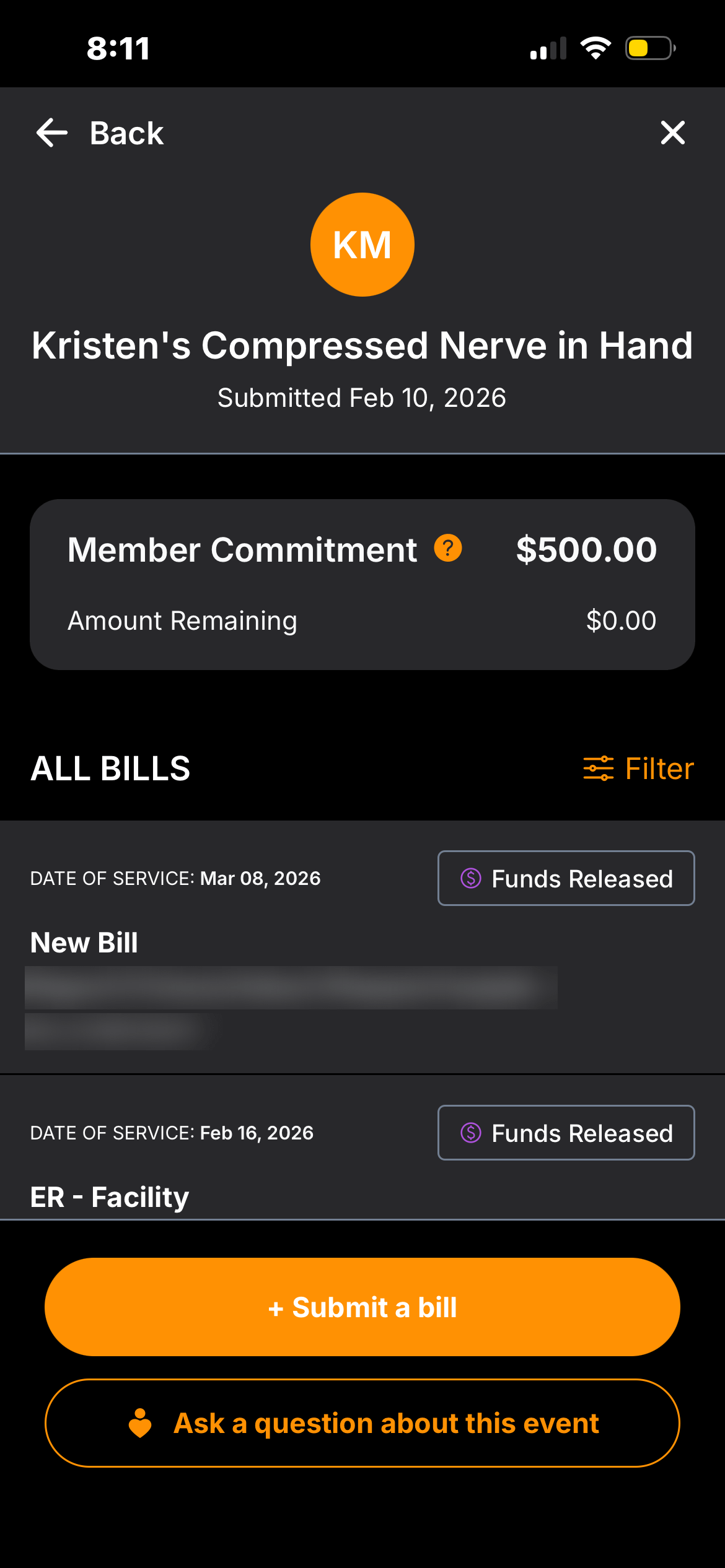
I paid the hospital bill out of pocket on March 9 and CrowdHealth funded it on March 10. I paid the doctor on March 11 and they funded it on March 12. Both times the money was back in my account the next day!
My cost for the whole thing was $500, which is what you cover on any health event. It’s kind of like a deductible per event rather than per year.
Run that same visit through the old plan and we’d have paid all of it ourselves (probably more, because the rates billed to insurance are generally always higher than the self-pay rate I was given), because we were nowhere near that $5,000 deductible, and I’d still have been paying $260 a paycheck for the privilege.
They made me go ask for a discount first
There was one thing that surprised me when I requested the bills be funded. CrowdHealth came back and asked whether I’d requested a discount on the bill. I said no. They said okay, go ask for a self-pay discount first. So I replied to the bill emails, and they told me the rate I had WAS the already discounted self-pay rate. I said as much to CrowdHealth and they immediately approved it.
They want to know you’re trying to get the best price, because it isn’t their money, it’s other members’ money. But to keep the system working, they want everyone to be working to be as healthy as possible and to get the best pricing possible.
Planned and diagnostic care works a different way
There is a second path I want you to know about before you need it, because my ER visit is not how most care goes. If something is planned or diagnostic rather than an emergency, you tell CrowdHealth first and they help you find the best price, including negotiating with the provider on your behalf. My husband thought he needed a CT scan and reached out to CrowdHealth to figure out next steps. They gave him the least expensive option within a radius but it was close to an hour from our house. When he pushed back on that, they said he could pick somewhere closer to us and they would work to negotiate a rate on our behalf before he had the test (which I very much appreciated!). So they give you options of places they have already negotiated with, but if that doesn’t work for you for whatever reason, they are willing to do your negotiating to make sure you get the best deal possible. In the end he didn’t end up getting this particular test after working with our DPC doctor, but it was helpful for us to see how it would work in a non-emergency situation. One thing to keep in mind, if the test was less than $500, and it was a new “event”, we would have had to pay fully anyway. So the rule of thumb I go by is that an emergency means get care and submit your receipts afterwards, and everything else means call them before you go. It’s not that dissimilar to pre-approval for insurance, except they aren’t trying to deny you whatever tests you need, just negotiate the best pricing.
$300 per person bonus
CrowdHealth gives every member a $300 annual wellness credit. Not per household. Per person. For our family of four that’s $1,200 a year, and you can put it toward anything wellness related - annual physical, labs, a chiropractic wellness visit, or your direct primary care charges.
We pay $299 a month for direct primary care for all four of us, so our wellness credits covered four months of it. All four of ours are claimed and funded for this year. Typical turnaround time was about 10 days from when I submitted the paid receipt to when the money was in my account.
As I mentioned above, the alternative care allowance money was the one thing I gave up when I passed on the other share. This credit covers some portion of those alternative choices, and unlike that other share, I didn’t have to fight anybody for it through CrowdHealth.
What it has actually cost us, January through August
We pay a membership fee of $240 a month for the four of us. That is the base to be part of the crowd and doesn’t change month to month. On top of that, as members request funds, we get asked to chip in. The most they can ask is $420, which makes $660 our monthly ceiling. So the monthly ceiling is the same cost as the health share I was considering, but it can be (and often is) LESS than that.
Here are the real numbers, January through August.
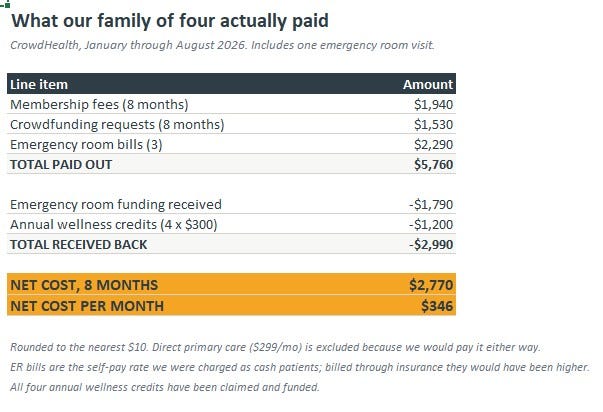
Membership fees: $1,940
Crowdfunding requests: $1,530
Emergency room bills: $2,290
Total paid out: $5,760
ER funding received back: $1,790
Wellness credits received back: $1,200
Total received back: $2,990
Net: $2,770, or about $346 a month for a family of four
Direct primary care isn’t in that number, because we’d be paying for it out of pocket under any plan.
The cheapest ACA plan we were quoted, Bronze at $1,681 a month, would have cost us $13,448 over the same eight months, plus that whole ER bill because we’d never have hit a $14,000 deductible. That’s about $15,740, and it’s where the at least $12,000 savings in the headline comes from.
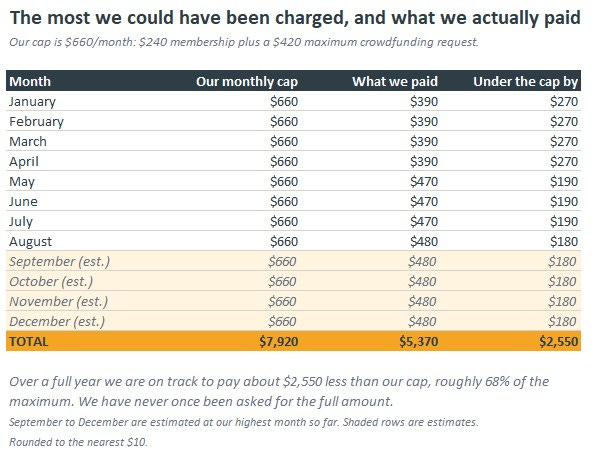
If you’re considering a plan like this, I think the most important number to know is the monthly ceiling to know your worst case. Over those eight months the absolute maximum they could have asked us for was $5,280, and we paid $3,463.56, which is about 66% of it. We have never once been asked for the full amount since we started.
It is a risk, and here is the gist of it
Crowdfunding as coverage is a risk, but based on my experience with insurance coverage there is a lot of risk there too because you never know what they will cover and what they won’t. In theory, when joining a crowdfunding membership, everyone is volunteering to pay everyone else’s bills. It’s a pool of people agreeing to pay each member’s bills, which is why they work so hard to make sure everyone’s being a good steward of other people’s money.
When CrowdHealth asks us to fund someone, we can say yes or no. If you say no, other members can see it, and if you decline more than once you get marked “red”, and then other people get to decide whether they feel like funding a red member. Most people set it to auto-fill “green” members, which is what we do, and I have never said no to one.
Again, this is not insurance. Nobody is legally obligated to pay my bill. If you have a complaint or don’t get paid, there is no state insurance regulator to step in for you. Nine months of clean funding is what I have, and I’m planning to stick with this system while we are all relatively healthy because it has absolutely been working for us. We are saving so much annually compared to the old system, we still have had coverage when we need it, and if something isn’t covered we look at it as though we are “self-insuring” with the money we have saved on premiums and deductibles.
The tax thing
If you’re self-employed this one may matter to you. ACA premiums (marketplace insurance) are 100% deductible as a self-employed health insurance deduction and CrowdHealth contributions are not, so some of what you save on the monthly number you hand back at tax time.
Who this might be a bad idea for
Before you jump in on this, a few words of caution (or rather things to check on).
You should check your state law first, before anything else. Some states still require ACA-compliant coverage and CrowdHealth cannot substitute. I found this out the hard way trying to set my dad up in New Jersey. Unfortunately it was a no go. CrowdHealth does list the affected states on their site.
65 is a hard cutoff age. Membership just ends, there’s no judgment call to be made. So if you’re close to that age, then this isn’t a good option, but Medicare kicks in then so you should have coverage from the government (at least as it stands right now…that’s another broken system that will probably collapse before I reach that age, lol.)
Tobacco use is a big one, because it is a lifetime disqualifier. Their wording is that if you have used tobacco products every day for a period of a year or more at any time in your life, you are not eligible to participate. Not currently, not in the last five years. Ever. So if you smoked daily in your twenties and quit thirty years ago, you cannot join at all (though I’m not sure exactly how they would determine this.)
Pre-existing conditions are excluded for your first two years, and capped after that. So if you’ve got things you’ve been dealing with for a long time, make sure you read the fine print as it might not be a good fit.
Neither cosmetic surgery nor fertility is included, and an ongoing prescription for a long-term medication isn’t something the crowd funds either. That one doesn’t keep you out, you just keep paying for it yourself. Read more closely for any other exclusions that might affect you before signing up.
If you’re at the doctor every week with multiple kids and your current plan genuinely covers unlimited visits, go check what coverage you have before you leave it. That was never my experience of insurance, but yours might be different and you should know what you’re leaving before you decide to switch.
Lastly, you do need to be able to pay a bill out of pocket and then wait for reimbursement. Our money came back the next day, or a week or two later for the wellness dollars, but I had to pay it myself first, and if a couple thousand dollars leaving your account for a week would break something, look at all your alternatives. When I had traditional insurance I would have had to pay that ER bill out of pocket anyway because it wouldn’t have met my deductible, so no difference to me, but everyone has different experiences.
How I’d evaluate any of these alternatives, not just this one
Before you decide on any plan (this one, or any other), I recommend you look at how many members there are. The members ARE the pool. If there aren’t many of them they can get flooded and be unable to pay, because paying is voluntary. More members means the cost spreads out and each individual ask is smaller. One of the health shares I was strongly considering ended up being much smaller than CrowdHealth and that swayed my decision as well.
You don’t actually need a DPC to use CrowdHealth
We have Direct Primary Care because we’ve had it for ten years and it’s a convenience thing for us. Unlimited visits, a portal, prescriptions called in, and they know me and my family instead of knowing who the next 15 minute appointment is.
If you already have a doctor you’re established with who takes self-pay patients, stay there. A sick visit or an injury would be a $500 health event, and your annual wellness exam gets up to $300 once a year for a physical or labs.
If I had known this existed back when my husband still had the corporate job, I probably would have switched sooner. I’ve thought the whole health insurance system has been broken for a long time and it just keeps getting worse, and sometimes dealing with the insurance paperwork is worse than dealing with the injury or the illness itself.
The short hit
Want out of traditional health insurance without going completely uncovered?
CrowdHealth is what we use, and so far I highly recommend it.
My rec? If you’re currently healthy, join before you need anything, and save the difference in premiums from regular insurance in case you need to cover something out of pocket.
The picks
CrowdHealth — joincrowdhealth.com, referral code L2WIWS. The fee is $60 per member per month. With the code your crowdfunding request is capped at $39 for the first three months, so $99 per member per month is the most you can be charged to start. For a family of four that is $396 a month, capped, for three months.
Compare to your own ACA quote — healthcare.gov
Before you go
After going down my rabbit hole, CrowdHealth is the one we chose based on our family’s needs, age, and health.
What would it actually take for you to leave your health insurance plan? I’d love to hear where people are on this, especially if you’re self-employed and running these numbers right now. Post what your quote came back as if you’re willing, because I think a lot of us assume everyone else is paying less than we are.
Talk soon,
Kristen ❤️
I used CrowdHealth for the 18 months before I was eligible for Medicare. This article is accurate. I highly recommend CrowdHealth.
I've never heard of this before. Very interesting, thanks for sharing your experience.