

Heads up: some links below are affiliate or referral links. I only ever link things I actually use.
LIVE WELL
AirDoctor vs. Jaspr: What I’d Actually Buy for Each Room
★ The Shortcut
The short hit
Want cleaner air without a whole-home install? The brand I run all over my house is AirDoctor, and it’s where I’d tell you to start. Jaspr is the splurge on a standalone unit if you want the prettiest, sturdiest machine, with a real-time screen and a lifetime warranty. Here’s how I’d actually spend it:
Bedrooms and normal rooms: a medium AirDoctor. I have the 3000/3500; I’d buy the 4000 new. One in every room where you sleep or sit a lot.
Open living/kitchen: size up. The AirDoctor 5500 for an open space, which cleans it at a full four changes an hour. Or spend slightly more on the Jaspr if you want the look and the build.
Office or anywhere you spend hours: add one there too.
Only buying one to start? Make it the bedroom. You spend a third of your life there doing most of your body’s repair work.
My rec? Wait for the AirDoctor sale (sometimes up to ~$300 off) and buy direct from their site where it’s cheaper than Amazon when it’s on sale. And run a HEPA vacuum over the filters once in a while to stretch their life.
The picks
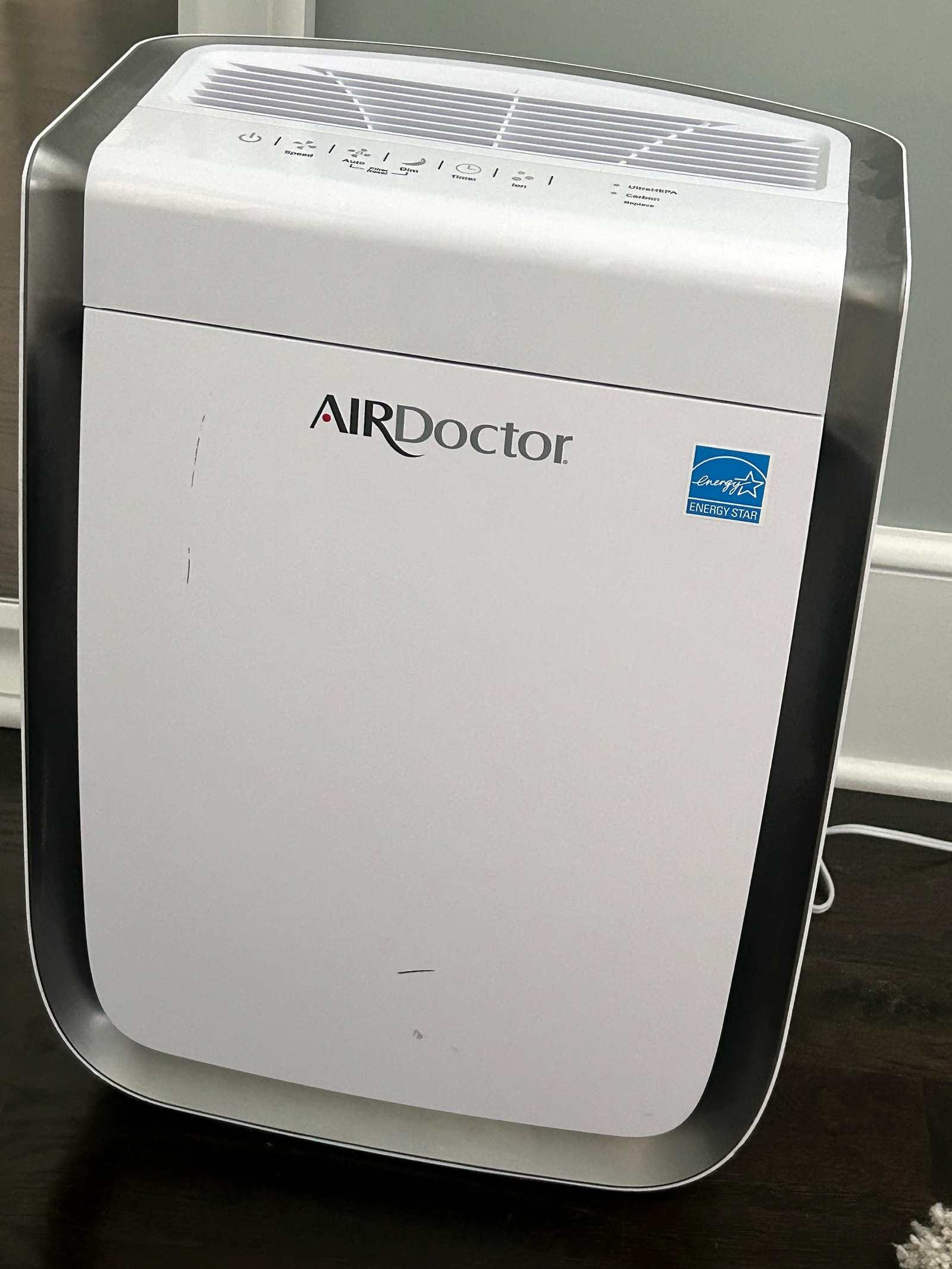
AirDoctor — what I run, and my everyday pick. I have the 3000/3500; I’d get the 4000 new for the look, or the 5500 for a large open space. I also highly recommend adding the full year of replacement filters onto Amazon Autosubscribe so you don’t have to think about it!
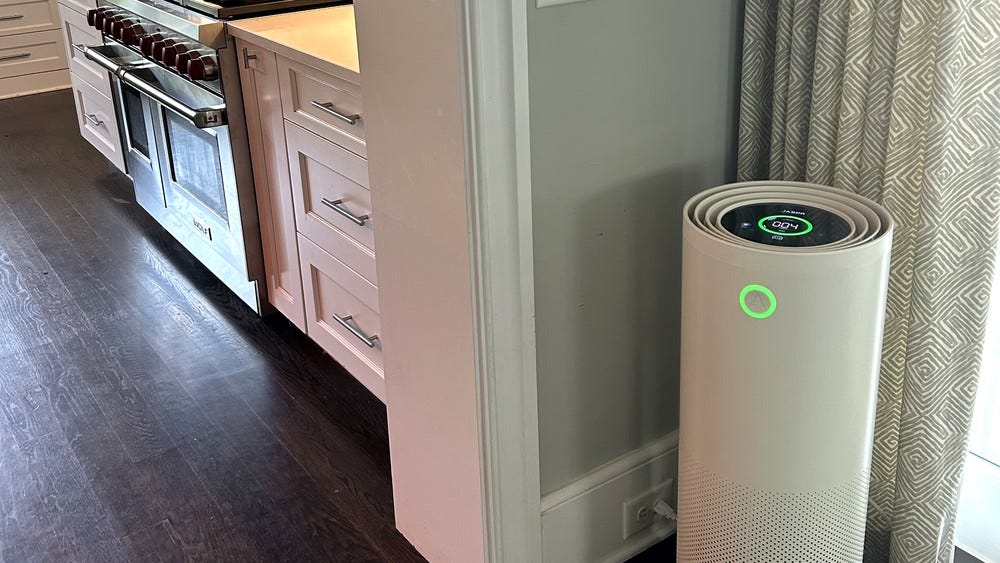
Jaspr — the splurge: steel build, commercial air-scrubber pedigree, real-time air-quality screen, lifetime warranty. Sold direct only.
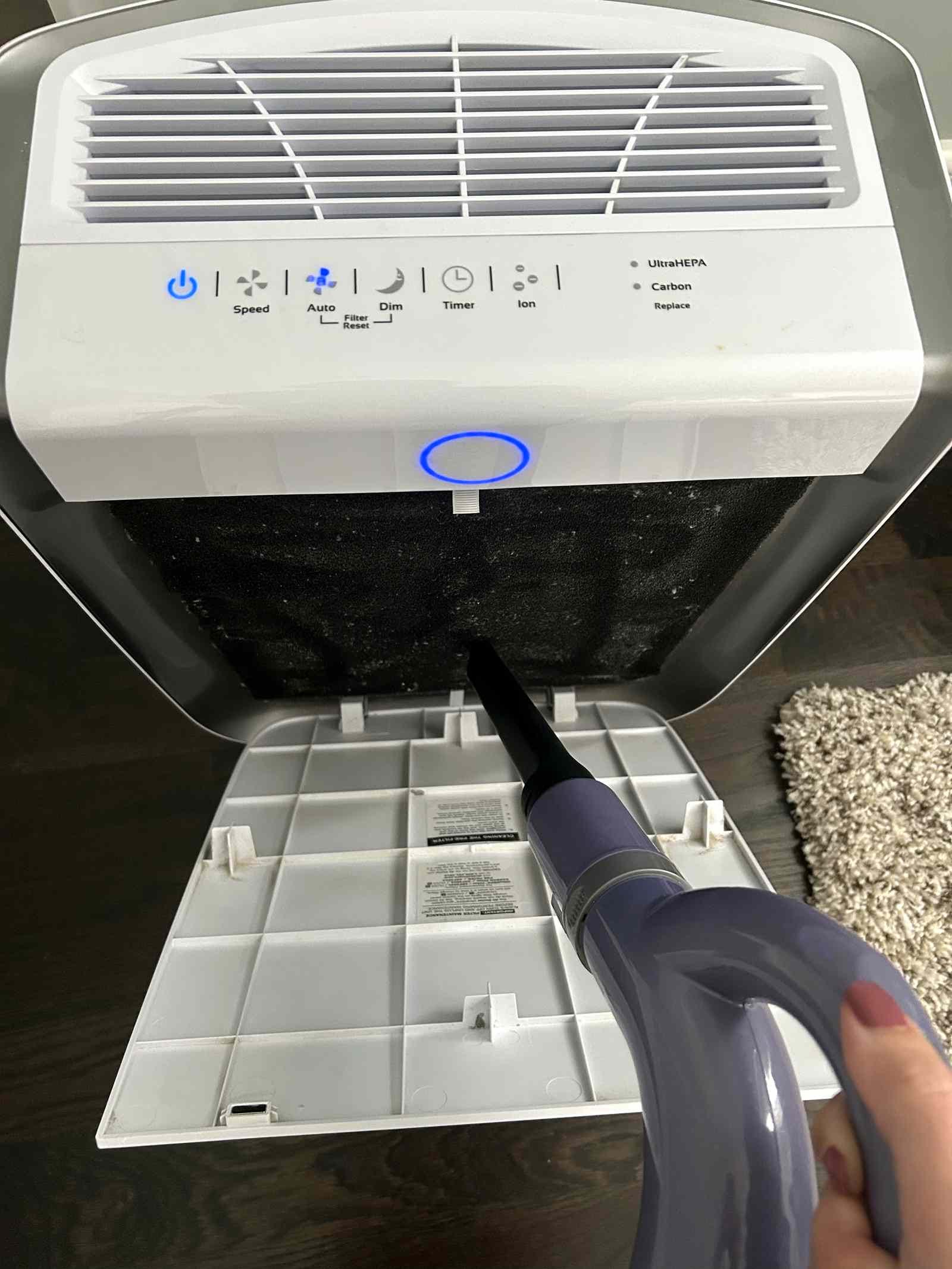
A HEPA vacuum for the filter-life trick — I use this Shark, but any HEPA vacuum works. We recently got this HEPA backpack vacuum too which would work great!
The story
One night while my son was cooking something in the oven, the whole downstairs went a little smoky. I grabbed the air filter out of our bedroom, carried it downstairs, and the second I plugged it in it shot up to high power and glowed red. We could watch it work. Once the air cleared, it dropped right back to normal and went quiet. I knew it was important to filter the air we breathe for things we can’t see, but that was the night I could actually see it happening.
Let me back up.
When I started cleaning up the personal care products in our house, I went down a lot of rabbit holes. What you put on your body matters as much as what you put in it. And in one of those deep dives, I learned the thing we’re most exposed to all day isn’t any product at all. It’s the air we’re breathing (and the water we drink, but I’ll save that for later.)
So I went down the path to learn about what I could do for air filtration. There are whole-home systems, but our house was already built, and that felt scary and expensive to touch. No whole-home system. No renovation. As a first step I needed something easy I could just plug in. I did the research deep dive. Austin Air Systems came up a lot in the wellness blogs I followed at the time (10+ years ago), but back then it was so expensive and not exactly something you want sitting out in a room as they were big and bulky. AirDoctor as a brand started popping up in places I was looking too. But honestly? Every wellness influencer around was pushing AirDoctor, so I was skeptical. I waited and waited in analysis paralysis and then they ran one of their sales, where you can usually get $300 off if you wait for it, and I caved. I bought two of their medium sized ones, the 3000 version at the time, one for our room, one for the nursery. We only had one kid then.
I didn’t really believe it but I could feel the difference in our bedroom. The air was fresher. We slept better. So I kept adding them, another baby, another filter, then one for the living room and kitchen based on the story I opened with.
As I mentioned above, I actually know they work because you can SEE the red light come on when they are working harder. When we cook, even when there’s no smoke, just the smell, they cycle up. A couple summers ago we got wildfire smoke/haze all the way here in Charlotte from Canada, and every time we opened a door the filters would climb to red even though it looked clear outside. One night every filter in every bedroom went red/loud overnight. Since it was every room at once it didn’t feel like a glitch, so I assumed it was something going on with our HVAC. We had someone come out to check, and sure enough we had an exterior exhaust issue and we fixed it. Now every single time the HVAC gets serviced, I notice the bedroom filters go red the day the techs leave, because they’ve stirred up all the dust that was sitting in the system. The filters catch it. That’s my proof they’re doing their job.
Here’s AirDoctor’s actual pitch, and what won me over past the influencer noise. They call regular HEPA a 1943 standard, and their UltraHEPA is independently tested to capture 99.99% of particles down to 0.003 microns, which they say is 100 times smaller than the ordinary HEPA cutoff. The second filter is a carbon/VOC filter aimed at the gases and odors most purifiers ignore, the off-gassing, the cooking smells, the cleaning-product fumes. They’ve even had it third-party tested to pull live viruses like SARS-CoV-2 and H1N1 out of a sealed chamber. So it isn’t only catching dust, it’s going after the stuff you can’t see or smell.
We’ve had ours for years at this point, even though they still get a lot of hype on the internet. You do have to change the filters, and there are two in each: a HEPA and a carbon. You swap the carbon one twice a year and the HEPA once a year. There’s an indicator light that tells you when it’s time to change one or another, so you’re not guessing. Yes the filters can get expensive, but then I remember THIS IS THE AIR WE BREATHE EVERY DAY and it’s important so it’s worth it to me to keep up with the cost of the filters. Here’s a tip someone passed me that I’ll pass to you: run your normal HEPA vacuum over the filters every so often (we do it once a month) and it stretches their life past the six-month or one-year mark. The light still tells you when they’re finally done and need a swap though.
My favorite feature? The “Dim” button. One push and every light goes dark, the panel, the LEDs, that glowing blue dot in your bedroom, gone. You can leave the panel on in the daytime if you want to watch the numbers, but we run ours on Dim, 24/7, in every room. I hate when an electronic in my room (which are minimal!) disrupts my sleep with the tiny LED light.
When we built our healthy home at the beach from the ground up, I knew I had the opportunity to add air filtration right into the build process (that’s its own post coming soon). Me being me, I was a little over the top about it all, and right after we moved in I knew I wanted a separate filter just for the VOCs, because brand-new furniture and other new products off-gas for a while. I’d been eyeing Jaspr for a while, it came out after I had already purchased all of our AirDoctors. It is a commercial-grade air scrubber and catches tiny particles like VOCs too, so I wanted to explore it more. It costs more than the AirDoctor (but still less than the OG Austin Air System), but it’s genuinely beautiful, and you only change out one filter every six months, sometimes less depending on use. During the California wildfires I watched a lot of people call it the next level up in air filtration, so I was intrigued. I ended up getting one for the beach, on top of the medical-grade system already in the HVAC system, as one more layer we could pull out whenever we were there.
What makes Jaspr different is where it came from: disaster restoration, the big commercial air scrubbers crews run after mold and wildfire damage. Jaspr basically shrank that machine into something quiet and pretty enough to live in your kitchen. It pairs a true HEPA with about a pound of activated carbon, and it shows your air quality in real time on a little screen, so you’re never guessing whether it’s working (you watch the number jump when you cook, same idea as the AirDoctor’s light but more detailed). It also skips UV light on purpose. Jaspr’s argument is that air moves through the filter too fast for a UV light to kill anything. They lean hardest on mold and smoke. If that’s something you’re concerned about, I’d look deeper at Jaspr.
I didn’t leave it out for rentals in our vacation property. It was for our first few trips during the off-gassing part with all the new furniture and materials in the house. After those initial months, I ended up bringing it home to Charlotte because with the full whole-house system at the beach we didn’t really need it there, and I wanted to run it against the AirDoctors side by side.
Here’s my honest verdict now that I’ve run both for years. People kept telling me the Jaspr was the next level up from AirDoctor, and I believed it going in. Side by side, I think the air comes out just as clean from the AirDoctor, and on paper AirDoctor’s filter is rated to catch even finer particles. Where the Jaspr earns its higher price is the build and the design: steel instead of plastic, a screen that shows your air quality in real time, and a lifetime warranty. If I were furnishing from scratch and wanted the prettiest, sturdiest machine for the main room, I’d still splurge on a Jaspr. Everywhere else, AirDoctor is what I run and what I’d tell you to buy first. On a budget: AirDoctor. Splurge: Jaspr.
One note on which AirDoctor, since there are a few. I have the 3000 model (now sold as the 3500), the older boxy ones, and they’ve been workhorses for years. If I were buying new today I’d get the 4000. It’s basically the same performance, but it’s the newest model and the design finally looks the part, much closer to the Jaspr (though not all steel), which was honestly the one thing the old ones were missing. And for a really big open space, they make a 5500 that clears over 1,000 square feet at that full four-changes-an-hour, right in the Jaspr’s territory (though Jaspr says it can cover even larger open areas.)
The Jaspr lives in our kitchen and living room now, because that open space needed more than the medium AirDoctor we’d had in there (a bigger AirDoctor like the 4000 or 5500 would cover it just as well, I just already had the Jaspr and love how it looks in that room). It blends right in. They’re all pretty quiet on the low settings, though some people crank the speed up in their bedrooms at night and use it as a white noise machine. I leave mine on auto, and when the air’s clean, you barely hear it.
If you want an air filter and are considering a cheaper one off Amazon or from a store, there’s one thing worth understanding first. You’ll find units of every size, down to the size of a water bottle, all making big claims about particle size and how much they capture. But the number that actually matters is how many times a machine can turn over all the air in the room, its airflow. Here’s the real comparison: AirDoctor rates my 3000/3500 to clean a 630-square-foot room four times an hour, the 4000 does 694 sq ft, and the big 5500 does over 1,000 sq ft, all at that same four-changes-an-hour the Harvard/CDC guidance recommends. The Jaspr holds that 4-changes pace up to around 800 square feet, then eases off, which is how it still covers 1,600 square feet at about 2 changes an hour. A sized-up AirDoctor like the 5500 keeps the full 4 changes across a bigger room. On particle size, AirDoctor’s UltraHEPA claims down to 0.003 microns and Jaspr runs a true HEPA to 0.3 microns. Square footage alone will fool you anyway, because high ceilings or a chopped-up floor plan take longer to clear than one open box. Bottom line, both brands blow the little Amazon units away.
Before you go
Do you already run an air filter, or is this the year you finally get one? Hit reply and tell me. I read every single one.
Talk soon,
Kristen ❤️
I have the Blueair purifier it works great.
I have two Blueair and one Dyson Cool. Got to have them as NM gets very dusty in spring.